Bubble Soccer FootballBubble Balls For Sale Norway
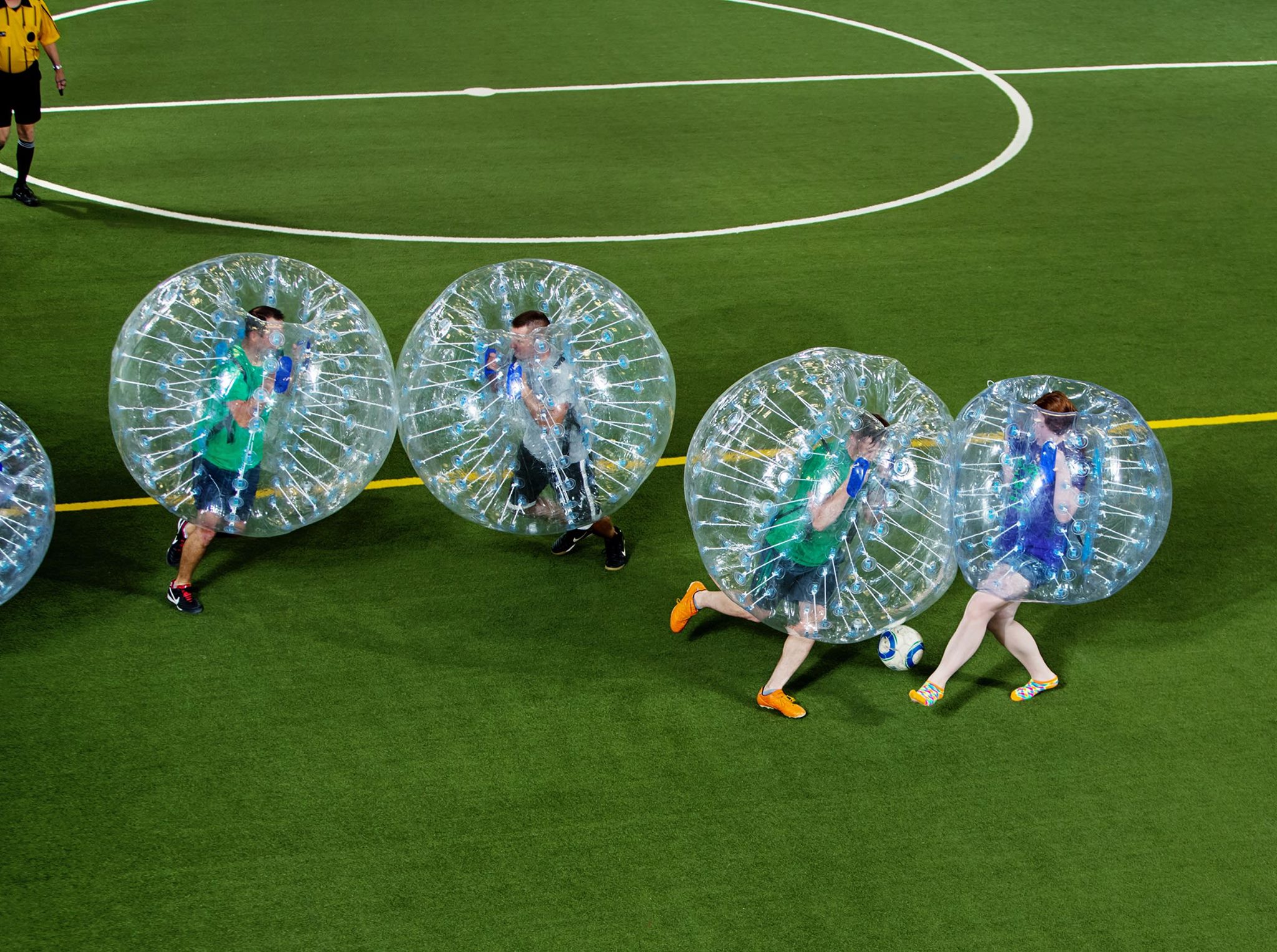
Bubble ball soccer is a relatively new sport on the athletic event scene. It appeared as an alternative to soccer, or football in other countries, with a few unheard of twists. First of all, bubble ball soccer is full contact. Yes, you read that correct, it’s full contact. It’s fairly common to see players flip through the air and do other insane movements that would be considered ridiculous in any other sport. The main reason that this is possible it the large inflatable hamster like balls that surround the players. These serve as a cushions for when the players run into each other or fight for the ball. Recently there has been a lot of debate surrounding the world of bubble ball soccer because of health concerns. Although the bubble does absorb much of the impacts, they also make the player’s arms immobile and can heat up in the hot sunlight during play. However these problems have not even phased the dedicated players who spend every opportunity they can on the field and practicing.
Bubble Balls Cheap Norway
Although this game seems like it would be fun to watch, and it is, it’s even more entertaining to play. There are numerous bubble ball soccer leagues throughout the nation and most major cities have several teams that compete every few weeks. Although some of these leagues are unofficial they still are just as much fun. Bubble ball soccer makes for an interesting hobby to do on the weekends or to mess around with some of your friends. Bubble ball soccer is a wonderful way to build relationships or learn for teams to work together. Corporate events are also very common and companies often like to encourage their teams to do events like this from time to time. All it takes is a little digging and the world of bubble ball soccer can be open to you!
2015年8月21日星期五

2015年7月19日星期日
The FAQ’S of Bubble Football UK
So here at NABS we talk to over 20 people a day around the USA interested in either playing or starting a bubble football league in their area. Oftentimes, the questions are always the same, so we figured we’d take some time to answer some FAQ’s about our Bubble football Leagues, the game play, and the Bubble football Equipment.

How safe is it to play Bubble Football?Zorb football
The risks associated to Bubble Football or Bubble football are the same as any other sport. There’s always a risk for injuries such as twisted ankles or bruised knees, but the risk isn’t really any higher than traditional football. There is more of a concern that the actual contact causes injury, but because the bubbles are so big, the concussive impact is actually displaced over the entire surface of the ball, so the player inside feels nothing! As far as concussive related injuries are concerned, we’ve never had any.
How is the game played?
The game is played just like a traditional football game with two halves, anywhere from 25-45 minutes per half. Teams play in team sizes ranging from 6-on-6 to full 11-on-11 football matches. It all depends on the type of terrain the game is being played on, the size of the facility, and the number of players in a particular league. The only difference between traditional football and bubble football is that sometimes players can’t get upright after being knocked down because of their laughter. It’s not uncommon for the referees to have to help them roll over to get up!
Is there a difference in quality of the bubble football bumpers?
Yes! As with anything else, there is a marked difference in high quality and low quality bumpers balls for bubble football that is associated to two aspects of construction: the plastic resin used and the manufacturing process. Many people assume that €plastic is plastic€ so any type will do, however it’s not the case. Oftentimes you may have seen videos of bubble football where the balls appear somewhat cloudy. The reason why is because lesser quality balls use a blend of plastics Bubble Football in their resin which can affect how light, temperature, and overall use will cause the ball to wear over time. Not only that, even more important is the type sealing used on the ball’s seams. If the seams are just heat sealed as opposed to ultrasonically welded, you’re going to have a huge difference in the durability of those seams. That’s why all our equipment is inspected for approval twice before we send anything out.
2015年4月13日星期一
Now Bubble Football is very popular in UK
bubble footballis physical,exhilarating,and enormous fun for children adn adults.Kidfun prodcues the most durable body zorb ball n mainland China.
Inside the body zorb ball your legs is free so it is to run,jump,walk,flip and do lots of funs and play lots of games suach as Body zorb football,Tag, Zorb Sumo,Bulldog zorb and many more.
Now Bubble Football is very popular in UK.Bubble Football have been see on TV and onBBC sport,even body zorbs have become part of the school sports scene in some schllos.Bubble Football will be more and more polpular woldwide in the furture.
Inside the body zorb ball your legs is free so it is to run,jump,walk,flip and do lots of funs and play lots of games suach as Body zorb football,Tag, Zorb Sumo,Bulldog zorb and many more.
Now Bubble Football is very popular in UK.Bubble Football have been see on TV and onBBC sport,even body zorbs have become part of the school sports scene in some schllos.Bubble Football will be more and more polpular woldwide in the furture.
How To Build A Bubble Football Team?
Can’t find enough partners to play or just like the idea of playing against others? Get in touch with us, and we will build you a team to form a game. Once we have a full team we will schedule the game on a day that suits everyone.
Or considering playing league Zorb football or tournament? We arrange competitions for different standards, age groups, different days and times.
Send us an enquiry email and we°Øll get back to you with details on the next league or tournament start dates.
2015年3月9日星期一
Bubble Ball Football Rules
We loosely follow traditional Football rules. For example, there is no Off-Sides! You start the game with the Football ball in the middle of the field. The players stand on their prospective goal lines & when the ref blows the whistle everyone runs to the ball at the same time resulting in some Bubble Ballers rolling around on the ground! The real fun is just beginning because when you crash into another player, both of you will go flying in different directions.
Each team typically has 5 players and at least 1 substitute
The game is exhilarating & exhausting so bring a sub if possible
Substitutions can be made during the game as needed
There are 4 periods lasting 12 minutes each with a few 2 minute breaks
Each team can call a 2 minute timeout during a half
All play stops immediately when the referee blows the whistle
No kicking or bumping into a player when they are are down
No bumping a player when they are trying to stand back up
Don’t knock down someone who is not facing you
No fighting – ejections will happen (no refunds)
No launching into anybodys legs at any time
No kicking the equipment (Bubble Balls)
If the Bubble Ball gets punctured please let the ref know
You must remain in the Bubble Ball when in play
Please arrive 20 minutes early to sign waiver & get comfortable in the Bubble Ball! Don’t forget to drink plenty of water so you stay hydrated during the game!
bubble football
bubble football uk
Zorb football Suits Shop
Zorb football
Each team typically has 5 players and at least 1 substitute
The game is exhilarating & exhausting so bring a sub if possible
Substitutions can be made during the game as needed
There are 4 periods lasting 12 minutes each with a few 2 minute breaks
Each team can call a 2 minute timeout during a half
All play stops immediately when the referee blows the whistle
No kicking or bumping into a player when they are are down
No bumping a player when they are trying to stand back up
Don’t knock down someone who is not facing you
No fighting – ejections will happen (no refunds)
No launching into anybodys legs at any time
No kicking the equipment (Bubble Balls)
If the Bubble Ball gets punctured please let the ref know
You must remain in the Bubble Ball when in play
Please arrive 20 minutes early to sign waiver & get comfortable in the Bubble Ball! Don’t forget to drink plenty of water so you stay hydrated during the game!
bubble football
bubble football uk
Zorb football Suits Shop
Zorb football
2015年2月15日星期日
The Lancashire bubble football uk
Although there is no published study exploring the relationship between the viewing of televised soccer and domestic abuse, there is a body of research that suggests this association could exist. Although commentators argue the complexity of domestic abuse requires a multifaceted explanation, attempts to explain it have generally fallen between individual and social–structural accounts (Robinson 2010). Individual or psychological explanations high- light the importance of personal factors, an example being ‘‘social learning theory’’ that argues specific behavior is determined through watching others. As commentators have argued, ‘‘Being a victim of physical abuse, or witnessing the abuse of other family members, teaches boys to become violent’’ (Bevan and Higgins 2002:225), and ‘‘the girl, seeing her mother as a victim of violence, chooses a violent partner and . . . becomes the victim’’ (Lockton and Ward 1997:29), thereby creating a cycle of violence (Fagan 2005). Other psychological explanations include mental health problems (which can also emanate from a difficult upbringing), posttrau- matic stress disorder, anxiety, depression,bubble football poor anger management, dissociation, frustration, and substance abuse.
Conversely, social–structural explanations, often created through feminist-led research, have focused on wider cultural factors, specifically the imbalance of power between males and females. In this way, violence is viewed as a symptom of wider situational concerns, being ‘‘ . . . . both a product and an expression (or ‘performance’) of socialisation,bubble football uk, and acculturation into narrow and persisting values of ‘being a man’, and into a society underpinned by asymmetrical power relations’’ (Thurston and Beynon 1995:181). ‘‘Lashing out at their partner can therefore be used to endorse impressions of masculinity or serve as a cathartic release to feelings of male inadequacy generated through social problems such as unemployment, poverty, or everyday stresses’’ (Agnew 1985:151). Indeed, an increase in domestic abuse has been associated with periods of high unemployment (Lockton and Ward 1997:28) and recession (Morris and O’ Grady 2009).
Turning more specifically toward soccer, the game has experienced a long cultural association with both violence and masculinity. Carnibella et al. (1996) have pointed out that general acts of violence have been asso- ciated with the game since its origins in thirteenth-century England and observed across much of Europe; specifically England, Italy, the Nether- lands, Germany, Spain, France, Czech Republic, Greece, and Albania. In fact, Quigg, Hughes, and Bellis (2012) found the 2010 world cup tourna- ment was associated with a 37.5 percent rise in admission rates across 15 hospital emergency departments on England match days. There also appears a similar phenomenon with American football; Rees and Schnepel (2009) found increased reports of assault, vandalism, and arrests for disor- derly conduct and alcohol-related offences while monitoring six seasons of college football. Similar to domestic abuse, commentators argue there is no universal explanation for football-associated violence explaining different reasons exist, dependent on country and situation. However, such explana- Zorb football tions again generally follow individual and sociocultural explanations. For example, studies have suggested that testosterone levels increase in individ- uals when watching football matches, a chemical associated with an upsurge in aggression, causing Bernhardt et al. (1998:59) to observe that fans identify with team success or failure as their own. Further, Swain (2000:103) argued, ‘‘Football (soccer) is full of aggressive intent, about winners and losers, territorial, space-occupying domination, and where loyalty and commitment to the side are prized values.’’
Although no prior study has associated soccer with domestic violence, this correlation has already been established with American Football. Card and Dahl (2011) found that home-based male-on-female partner violence increased by 10 percent following a televised upset loss, experienced by their home National Football League team. This behavior was concentrated at the end of the game and became more pronounced for the most important matches. Other situational factors have also been associated with interper- sonal conflict. Television influences both attitude and behavior not only because of the content but because it generates changes in interpersonal interaction (Dahl and DellaVigna 2009). Gantz, Wang, and Bradley (2006) established that program preference disputes between husbands and wives are greatest when watching televised sports. Similarly, in the United Kingdom, there has been a move to display soccer games on large screens in public bars bringing individuals together in confined social spaces. Finally, alcohol is a commonly observed factor associated with both football violence and domestic abuse. The risk of partner violence is ‘‘often increased by excessive drinking and poorly managed emotions’’ (Baron 2010), a finding supported by Gayford (1975:196) who, surveying 100 domestic violence victims articulated a picture, ‘‘… of men with low frustration tolerance, who often completely lose control under the influence of alcohol.’’ Indeed, one study highlighted alcohol consumption as a con- tributory factor in 36 percent of domestic abuse cases (Lockton and Ward 1997:28).
These facilitators play a significant bubble soccer role in theories that enhance the importance of context when understanding and reducing crime. Rational choice theory (Felson 2002), for example, argues crime occurs as a result of the normal rhythms of everyday life. In this way, commentators have established domestic violence occurs more frequently on weekends (Gantz et al. 2006; Vazquez, Stohr, and Purkiss 2005) and on exceptionally warm days and major holidays (Card and Dahl 2011). Although Oths and Robert- son (2007) reported no increase in women seeking refuge in ‘‘safe houses’’ during established ‘‘drinking holidays’’ (i.e., the U.S. Superbowl), the fact they were more likely to flee during extended school holidays makes it possible this decision making was more aligned to pragmatism than the level of incidents. What does appear clear is that situations have an effect on offending patterns and as new situations are generated they create the condi- tions for further offences to take place. Extending this view, it is possible to imagine how watching the world cup tournament (even remotely) in close proximity to others can heighten the stressors associated with domestic abuse.
2015年2月10日星期二
Intensifying Rivalry Does not Amount to Cold War
Shortly after US President Obama and Australian Prime Minister Julia Gillard sealed the bilateral defense deal in November 2011 under which 2500 US marines will be stationed bubble football suits in Australia came Obama’s announce- ment on January 5 2012 of the new strategic defense guidance entitled Sustaining U.S. Global Leadership: Priorities for the 21st bubble football Century Defence. The document claims that China’s rise might have impact on the US econ- omy and security, and that countries such as China and Iran continue to pursue asymmetric means of countering US power projection capabilities.1 Both the Chinese Ministry of Foreign Affairs and the Ministry of Defense refuted these claims, arguing that not a shred of evidence exists to support such wild accusations.2 Many media reports nevertheless argue that compe- tition between the United States and China amounts to a new Cold War.3
Different Views of Trends in Sino–US Relations
The conflict between China and the United States at the 2009 Copenhagen Climate Talks gave rise to the mainstream view within US Zorb football academic circles that Sino–US ties are worsening. Paul Pedrozo and Seth Cropsy argued that competition between China and the United States was a necessary outcome of China’s naval modernization.4 Robert Kaplan, meanwhile, contended that China’s growing military capacities and economic power made heigh- tened tensions in Sino–US relations inevitable.5 Thomas Christensen holds that relations between the two countries will come under stress as China shifts towards a hard-line policy with respect to its sovereignty and territor- ial claims.6 While in 2010 US academics blamed China for the deterioration in Sino–US relations, Chinese scholars regarded the worsening of ties in 2011 as obviously a result of the Obama Administration’s beefing-up of its pivot strategy in the bubble football equipments Asia Pacific region. Scholars are nonetheless split on whether the pivot constitutes a strategy adjustment or a tactical adjust- ment. Those arguing the former predict long-term competition between China and the United States; those who see it as a tactical adjustment regard the deterioration in Sino–US ties as temporary, that is to say, Obama’s pivot strategy in the Asia Pacific region is part of his 2012 electoral strategy that he will drop after the elections and revert to his 2009 policy towards China. We identify three distinct views regarding the future of Sino–US relations.
Pessimists argue that Sino–US relations are entering a new Cold War period. Henry C. K. Liu suggests that a new Cold War is brewing between bubble soccer China and the United States, but that it is more geopolitically framed than ideologically based, albeit couched in residual ideological polemic.7 William Jones goes as far as to expect conflict between China and the United States to culminate in a third world war.8 Yongnian Zheng also considers that East Asia is headed towards a new Cold War dynamic that has prompted devel- opments on the Korean Peninsula.9 Mearsheimer holds that it is not possible for China to rise peacefully. He argues that ‘if China continues its impressive economic growth over the next few decades, the United States and China are likely to engage in an intense security competition with considerable poten- tial for war. Most of China’s neighbours, to include India, Japan, Singapore, South Korea, Russia, and Vietnam, will join with the United States to con- tain China’s power.’10 Lawrence S. Wittner even infers the possibility of nuclear war.11


Those more optimistic about the future of Sino–US relations are bubble football suits and primarily Chinese scholars, who generally believe that it is possible for China and the United states to avoid a new Cold War. Wu Jianmin argues that China will not as a matter of national policy enact the role of a hegemon, but follow the historical trend of peace, development and cooperation and absolutely reject war, competition and conflict. Under no circumstances, therefore, will China enter into a new Cold War with the United States.12 Wang Jisi has long held that while China and the United States will not become allies, nor will a crisis in their ties arise of an extent amounting to Cold War.13 Wang argues that the structural contradictions that appeared between China and the United States in 2010 are attributable to the narrowing gap in their respective bubble football buy comparative capacities which, conversely, have driven them fur- ther apart in terms of mutual understanding. Major issues such as Taiwan, the Korean Peninsula and the exchange rate have had escalating negative impact on Sino–US ties and created higher levels of strategic suspicion rather than mutual strategic trust.14 This implies that as long as the United States and China bolster strategic trust they can prevent their bilat- eral relationship from slipping into a Cold War scenario.
订阅:
博文 (Atom)